
Many freelancers have a story about a client who paid late, paid less than agreed, or never paid at all. Escrow fixes this by changing the order of trust. The client puts the money aside first, and you do the work knowing it is there.
What escrow means
Escrow is a simple idea. A neutral party holds the money while a job is being done. It is not yours yet, and it is not the client's to spend on something else. When the agreed condition is met, usually that the client approves the work, the money is released to you.
The neutral party can be a company, like a freelance platform or an escrow service, or a piece of code called a smart contract that follows fixed rules.
How escrow works for freelance work
- You and your client agree on the work, the price and the deadline.
- The client pays the full amount into escrow before you start.
- You can check that the money is there, then start the work.
- You deliver. The client reviews it.
- The client approves, and the money is released to you.
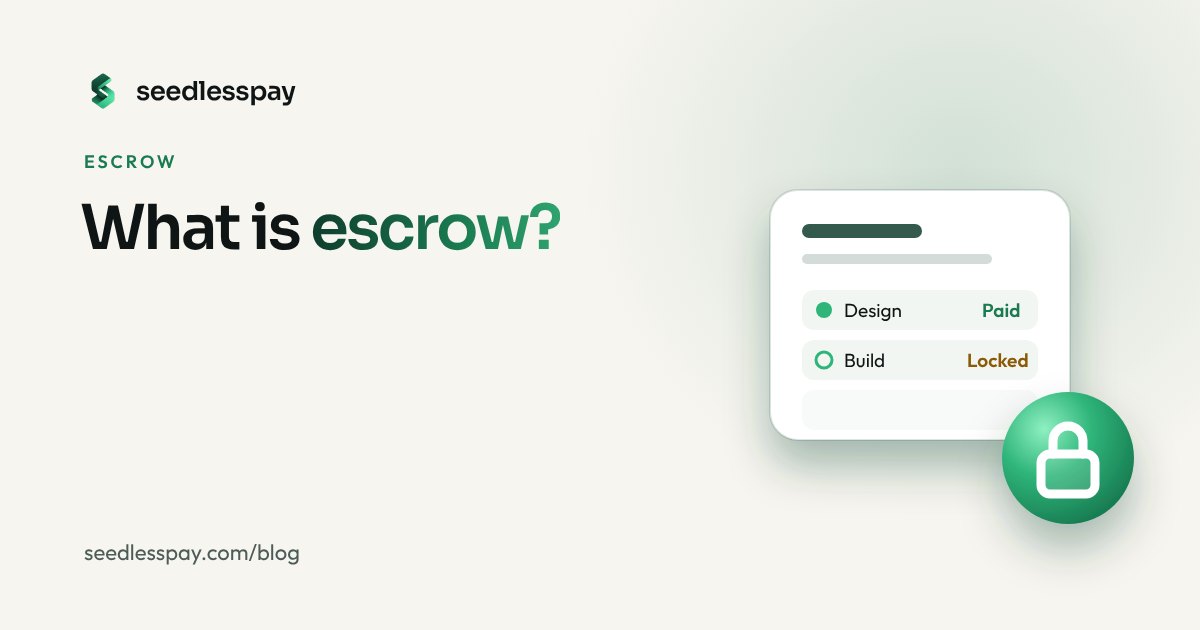
For bigger projects, the work is split into milestones, such as design, build and launch. Each milestone has its own amount and is released on its own, so you get paid as you go instead of waiting until the very end.
What escrow protects you from
- A client who cannot pay. If they cannot fund escrow, you find out before you spend a single hour on the job.
- A client who disappears. Good escrow has a time limit. If you deliver and the client says nothing for a set number of days, the money is released to you anyway.
- "I'll pay next week." The money is already committed, so there is nothing to chase.
What escrow does not do
Escrow is not a judge. It cannot tell whether your work is good. If the client says the work is not what they asked for, someone still has to sort that out. On platforms, that is usually a support team. With a smart contract, the rules decide, for example by returning the money to the client if a dispute is not settled in time.
That is why clear scope still matters. Write down what you will deliver, how many revisions are included, and when each part is due. Until a milestone is approved, share previews or watermarked files rather than final files.
What escrow costs
This is where options differ a lot.
- Freelance marketplaces include escrow, but take a cut of every payment. Upwork's freelancer fee, for example, ranges from 0% to 15% per contract.
- Escrow services and platforms often charge somewhere between 3% and 10%, sometimes split between you and the client.
- Smart contract escrow costs only the network fee, which on networks like Avalanche is usually a few cents, plus whatever the app itself charges.
Always check the current fee page of any service before you use it. Fees change.
When you should use escrow
- A new client you have never worked with
- A large project, or one that will take weeks
- A client in another country, where chasing a payment is hard
- Any client who asks you to start before paying anything
You probably do not need it for a client who has paid you on time for years. Escrow is about reducing risk, and with some clients the risk is already low.
How to suggest escrow without sounding rude
Present it as protection for both sides, not as a sign that you do not trust them. The client is protected too: the money only goes to you when they approve the work, or after the review time if they say nothing. We wrote a separate guide with message templates: how to ask a client to pay upfront.
How escrow works in SeedlessPay
SeedlessPay is built around this idea. You create an invoice and split it into up to 5 milestones. Your client pays the full amount into a public smart contract on Avalanche. Nobody owns that contract, so not even we can move the money outside its rules.
- When you deliver a milestone, your client has 7 days to approve it or raise an issue. If they do neither, you can claim it.
- If a milestone is not delivered by its due date, the client can take that part back.
- If an issue stays unresolved for 30 days, the money goes back to the client, unless you both agree on a split first.
SeedlessPay is in beta on the Avalanche test network, so you can try the whole flow with test money today.